
{主关键词}
女帝
Pakistan ‘one of the most dangerous nations’: Biden_我的网站

一 | Washington, Oct 15 (UNI) US President Joe Biden has called Pakistan one of the most dangerous nations in the world.
Biden was speaking at a Democratic congressional campaign committee reception on Thursday, when his comment on Pakistan was made, a transcript of the address, published on the White House’s website, quoted Biden as saying: “… And what I think is maybe one of the most dangerous nations in the world: Pakistan. Nuclear weapons without any cohesion.”
There was a lot at stake, Biden said, emphasising that the US had the capacity to lead the world to a place it had never been before. He asserted "The world is changing rapidly, so much so that it is beyond control, not because of any one single individual or one nation though,"
“Did any of you ever think you’d have a Russian leader, since the Cuban Missile Crisis, threatening the use of tactical nuclear weapons that would — could only kill three, four thousand people and be limited to make a point?
“Did anybody think we’d be in a situation where China is trying to figure out its role relative to Russia and relative to India and relative to Pakistan?”
Talking about his Chinese counterpart Xi Jinping, the US president termed him as a man who knew what he wanted but had an “enormous” array of problems.
“How do we handle that? How do we handle that relative to what’s going on in Russia? And what I think is maybe one of the most dangerous nations in the world: Pakistan. Nuclear weapons without any cohesion,” Biden said.
He said this while talking about the Russia's invasion of Ukraine and its impact on the world as well as US' relationship with other countries.
He also pondered on America's equation with Pakistan and China.
On Pakistan, Biden said “maybe one of the most dangerous nations in the world: Pakistan. He explained his comments adding "Nuclear weapons without any cohesion.”
Reflecting on his relationship with China, Biden said his predecessor Barack Obama had assigned him the task of engaging with Xi Jinping.
“I’ve spent more time with Xi Jinping than any person in — any head of state in America — (or) in the world. I spent over — they keep count of it — 78 hours’ worth.
"Of that, 68 were in person, over the last 10 years, because Barack knew that he couldn’t be dealing with a Vice President. And so, he assigned me," the US president said.
“This is a guy who understands what he wants but has an enormous, enormous array of problems,” Biden said about Xi.
The US President said Vladimir Putin's aim was to split North Atlantic Treaty Organization (NATO).
"One thing that Putin decided — counted on was us splitting NATO. Not a joke. Splitting NATO. And look what’s happening. Look what’s happening in the eastern front of NATO."
His comments came a day ahead of Putin's who at an Astana event said he had no wish of engaging with Biden.
UNI ING。
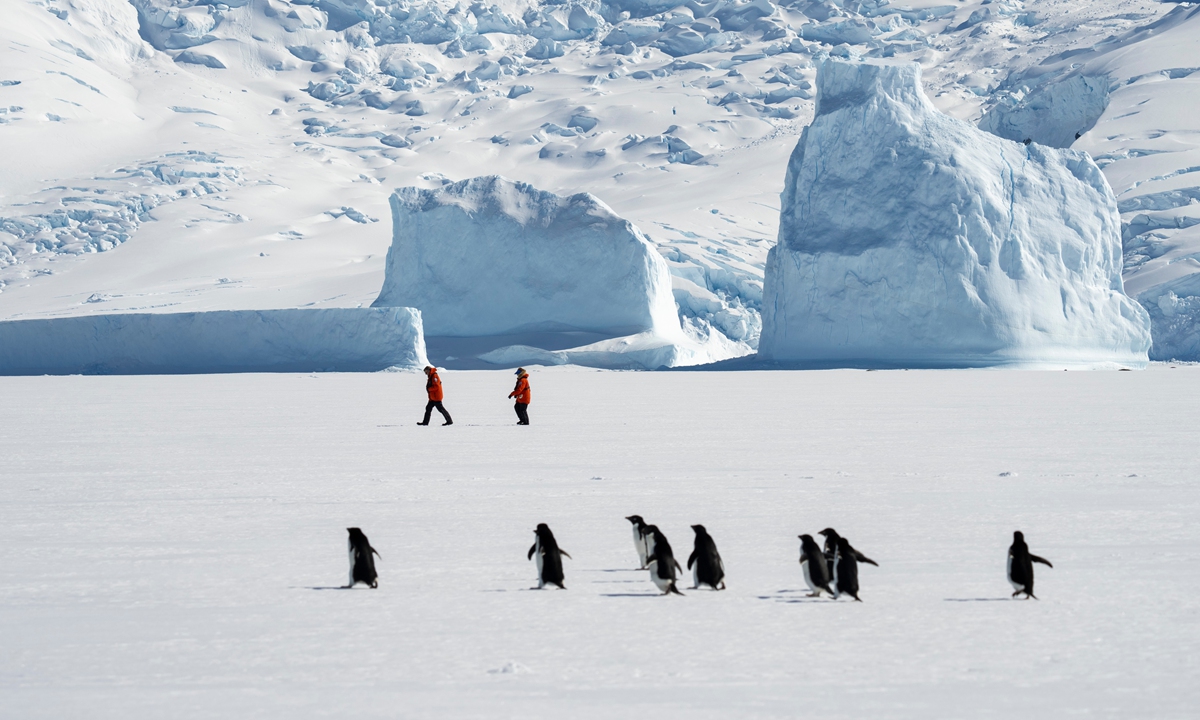
Joint research by Chinese and international scientists have found that the rate of long-term Antarctic mass loss has slowed, driven by sea surface temperature anomalies in the remote tropical warm pool, China Central Television (CCTV) reported on Thursday, citing a statement released by the Institute of Oceanology, Chinese Academy of Sciences (CAS).
The Antarctic ice sheet is one of the major sources of uncertainty in global sea-level rise forecasts. From 2003 to 2024, the Antarctic ice sheet lost an average of approximately 140.5 billion tons each year, CCTV reported.
However, Chinese and foreign scientists have found that the Antarctic ice sheet gained roughly 695 billion tons between July 2021 and April 2023, the largest 22-month mass gain seen in nearly two decades via satellite gravimetry, the Institute of Oceanology, CAS announced on Thursday.
The scientists found out that from 2021 to 2023, sustained heavy snowfall in East Antarctica led to significant increases in snow accumulation, partially offsetting the ongoing ice loss in West Antarctica.
The scientists' research shows that this was caused by tropical ocean-driven atmospheric processes that altered moisture transport pathways and increased snowfall over Antarctica.
The research was conducted by the research team at the Institute of Oceanology at CAS, along with peers from countries including the US, Hungary and Japan. It was published in the academic journal Nature on Wednesday.
According to Wang Yunhe, first author of the research paper and an associate research fellow at the Institute of Oceanology, sea surface temperatures in the tropical western Pacific warm pool remained unusually warm from 2021 to 2023. As one of the regions with the highest sea surface temperatures and strongest heat release into the atmosphere worldwide, changes in this region can reshape atmospheric circulation.
The persistently warmer-than-normal seawater triggered large-scale atmospheric waves.
After reaching the high latitudes of the Southern Hemisphere, the waves reshaped wind patterns and moisture transport pathways. Moisture-tracking simulations show that water vapor from the mid-latitude Indian Ocean fueled heavy snowfall in East Antarctica, leading to a recovery in ice sheet mass.
Observations and climate simulations suggest that such warming events occur roughly once a decade. But these temporary pauses are not enough to reverse Antarctica's long-term ice loss. The West Antarctic ice sheet continues to shrink, while parts of East Antarctica remain increasingly vulnerable to warmer ocean waters melting ice shelves from below and speeding the flow of glaciers into the sea.
The study shows how persistent warming in the tropical warm pool can contribute to the recovery of Antarctic ice-sheet mass, highlighting the role of East Antarctic atmospheric circulation in connecting tropical climate shifts with changes in the ice sheet. The findings point to a previously overlooked climate link between the tropical warm pool and East Antarctica, offering a new perspective on how distant climate systems may shape the continent's future.
Global Times
。
Current article:http://riy6gj6.guizhuanguchuanluanzhoudi.shop/83l1m8t/20260826/32730.html
Published on:22:15:35
- 上一篇:一影院推出“午休服务” 睡2.5小时仅1元多
- 下一篇:花间颂粉饼过敏商家恶意拒退款
- 97829Aamir Khan Praises Dhurandhar, Reveals He Is Yet to Watch The Film
- 25630Janet Jackson's 1989 Hit 'Rhythm Nation' May Literally Crash Laptops, Microsoft Says
- 479444长城汽车 2026 年上半年归母净利润 24.65 亿元,同比下降 61.11%
- 674350卡特队长遭绯红女巫“腰斩”!演员炮轰漫威不尊重角色
- 40723NBA官宣完整赛程!10大球星回归战敲定 4队拥有最多全美直播场次
- 526女子遛狗不牵绳致狗被车撞伤,治疗花费8000余元,起诉车主和保险公司索赔医疗费、狗贬值损失等,法院:狗主人主责
- 51295上海:实施新一代智能制造工程 累计建设500个先进级智能工厂
- 27104乒超大冷门!王楚钦输给世界第249名
- 71929麦迪签下阿迪达斯千万合约 取50万现金肆意打滚
- 785沈阳铁路12306:支付宝购票可获得3-100元的红包。
- 8615企业网站建设服务:从栏目规划到上线维护需要注意什么
- 3547大水什么时候能退?为什么又不能退太快?
- 143862“真假花生”背后,藏着具身智能的最后一块拼图
- 578525普京密集任命
- 6424公积金新政密集出圈!成都首创“首付15%+利息补贴”模式
- 313U18男篮亚洲杯最佳阵容:张懿赵杰入选 澳大利亚两人巴萨兰MVP
- 8128燃油车大幅降价,刚买的车就贬值?买车用车避坑指南
- 948クリアファイルを上からスポッと被せるだけで→「天才やんけ」 洗濯に革命が起こるアイデアに「よく思いつくなぁ」
- 3911《血が繋がった子どもですから…》中村獅童、離別した竹内結子と息子への誓い “酔うと手が付けられない”騒動後に酒を控えている現在
- 9622455机器人终于学会了“用手感受”:马里兰大学等机构联合研发的触觉残差学习系统,让视觉机器人从“看着做”进化到“摸着做”
- 1593全国抗议示威造成交通瘫痪 毛利党:这是一系列抗议行动的开始
- 801270严惩重刑犯,新西兰政府恢复这项争议法律!
我的网站热门国内
- Copyright @ 2016-2017 我的网站 版权所有